American Dynamism for the American Dream
Technology as the key platform for social change at scale

A marriage made somewhere close to heaven
In his latest book, British journalist Martin Wolf writes about the challenging “marriage” between democracy and capitalism. Core parts of both systems are at fundamental odds with each other, but history shows that they also need each other to survive and thrive.
Tech and government seem to have a similar “love-hate” relationship.
When I was in college during the 2010s, it was more hate than love.
Uber and AirBnB faced regulatory opposition in nearly every city, Mark Zuckerberg had to testify before Congress about Facebook’s data protections and impact on the 2016 election, and Google’s shutting down of Project Maven was the precursor for the current tensions between Anthropic, OpenAI, and the Department of War.
Yet, today feels different.
Patriotism is at the center of not just AI, robotics, and space, but also public safety, drones, manufacturing, supply chain, energy, and infrastructure. a16z is one of the leading investors, champions, and coiners of this “American Dynamism” movement where they hope to bring more harmony between Silicon Valley, DC, and the Heartland.
What’s really driving the return of “Atoms”
Base Power’s viral ad from last fall captures this budding spirit:
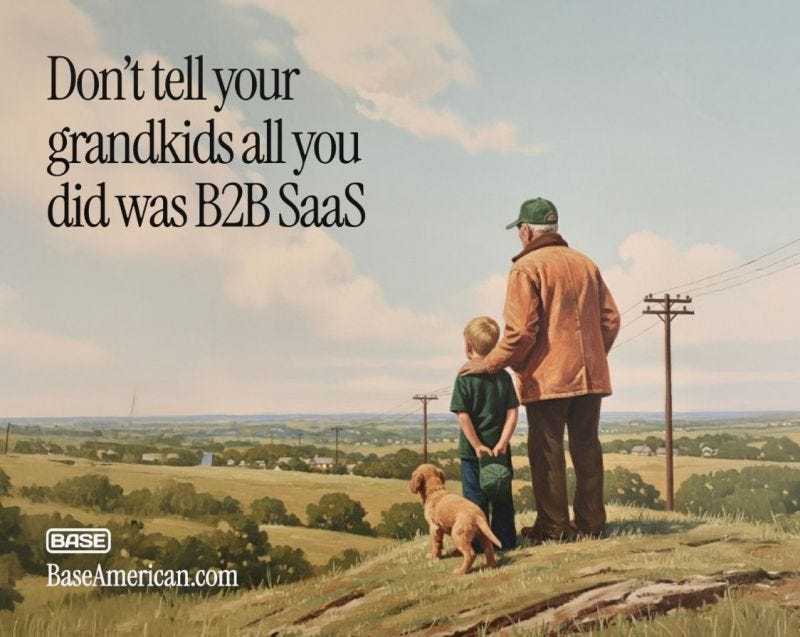
Enterprise AI may be having its greenfield moment now, but it’ll switch to brownfield sooner rather than later (if it hasn’t already).
It’s not just about “atoms” vs. “bits” or the cache of “hard” and “frontier” tech.
Being “mission-driven” as a company has become table stakes largely because having “purpose” and “meaning” from work feels more essential for every subsequent generation of top tech talent.
Founders Fund urges Silicon Valley’s best and brightest to “choose good quests” where the path to ROI at the start is long, hard, and fuzzy (if not completely invisible), but the impact of success is so great that doing anything else would feel like a waste.
“Today, Silicon Valley faces a crisis of nonsense. With no shortage of problems, and no shortage of both young technologists and well-capitalized former founders capable of solving them, our best and brightest have largely lost themselves to easy money, the attention grind, and early retirement. In tech especially, for all of the industry’s rare potential, such abdication of responsibility does not only constitute a failure of progress, but a moral failure.”
- Founders Fund
This moral failure extends beyond the call for more breakthroughs in science and industry.
We need American Dynamism for the American Dream.
250 years ago, to be a great American founder meant that one’s life work was as a groundbreaking political and social scientist, not (just) natural and computer scientist. They were engineers of their own vision for human civilization, not (just) machines and code.
In the 18th, 19th, and 20th century, policy was how our leaders moved the country closer to living up to our noble ideals.
In the 21st century, technology is already starting to replace policy as the best platform to create our desired social outcomes at scale.
We don’t look to just the Bureau of Labor Statistics (BLS) for insights on the job market; we also look to LinkedIn.
We don’t look to just the Small Business Administration (SBA) to fund “Main Street” businesses; we also look to Square, Shopify, Stripe, PayPal, Squire, and Toast.
We don’t look to just unemployment insurance programs to help people weather job transitions; we also look to gig platforms like DoorDash, Uber, Lyft, GrubHub, Instacart, Amazon Flex, and Shipt.
We don’t look to just public K-12 and higher education to teach nontraditional learners; we also look to Khan Academy, Coursera, Duolingo, and Oboe.
We don’t look to just nonprofit credit unions to democratize access to financial services; we also look to Robinhood and Chime.
We don’t look to just the Department of Housing and Urban Development (HUD) to improve the real estate market; we also look to Opendoor and AirBnB.
The passion driving many tech leaders is a deep, profound loyalty to seeing American ideals of freedom and opportunity prevail in the world. They should have more to offer than an endorsement in favor or against UBI.
I don’t buy that they don’t play a more active role because they don’t care. I know they do.
As tech rewrites the laws of physics (both figuratively and in some cases literally) with new technologies across every frontier and turns what used to be considered science fiction into just science, I also don’t buy the excuse that they think politics is too complex or controversial.
We needed calls from top founders and VCs to give more technologists permission to do more with their skills than B2B SaaS and Enterprise AI, so perhaps tech doesn’t feel like it’s place to contribute.
If that is the case, on behalf of everyone in government, nonprofits, academia, and philanthropy who are committed to reviving the American Dream, consider this permission granted for tech to not just join the conversation, but lead from the front.
The future Jeffersons, Lincolns, and Kings won’t just use laws and words to make America more just and fair. They’ll use code and capital.
Tech should certainly re-build, strengthen, and protect America’s “hardware” (our people, safety, and core systems), but we also need them to help re-program our country’s “software” (how our institutions make the American Dream a reality).
It’s time for American Dynamism for the American Dream to have its greenfield moment, and Open Work aims to be one of those platforms.
If you’d like to join a group of economists, engineers, executives, and elected officials exploring what Open Work could mean for economic opportunity in the U.S. and abroad, send me a note on LinkedIn and I’ll invite you to our group.